June 1, 2011
 |
| Proposed route of pipeline |
In the plenary talk on the last day of the International Marine Conservation Congress, Kyle Clifton, of the Gitaga’at First Nation of British Columbia, discussed traditional and contemporary marine resource management practices. At the end of his talk he noted there is now a much bigger threat to sustaining the health of the marine resources of the area than at any time in the past. In 1972 Canada’s federal government imposed a moratorium on tanker traffic on the Canadian portion of waters along the Inside Passage, the marine route from Puget Sound to the north ending in the Alaska Panhandle at Juneau and Skagway. It is called the Inside Passage because it is to the east of many offshore islands of British Columbia and southeastern Alaska. The ban was put in place to prevent oil tanker accidents in this environmentally rich and scenic area. Polls show the public in British Columbia remains overwhelmingly (>75%) averse to lifting the ban on oil tanker traffic, and support for this ban is nearly universal among native peoples of the region whose coast would be impacted by an oil spill. However a $5.5 billion dollar project called the Enbridge Northern Gateway proposes building two 1,170 km oil pipelines across large areas of First Nation’s territories. The pipeline would take oil from the central Canadian tar sand area in Alberta across the Rocky Mountains through forests and more than a thousand rivers and streams to a new terminal and docking facility at the port of Kitimat, located up a long narrow inlet on the British Columbia coast in the heart of the Great Bear Rainforest. One pipeline would transport 150,000 barrels of oil tar condensate per year, the other 400,000 barrels of oil per day to the coast for export to Asia.
If approved the proposed oil export scheme would, for the first time in this part of the British Columbia coast, involve more than 200 tankers a year transiting the narrow channels and rocky shallow reefs out from Kitimat and along the foggy coast of the British Columbia’s Inner Passage. The goal of shipping the tar sands oil to China and Asia is problematic in expanding development of the Canadian Tar Sands, considered by many to be the source of the world’s environmentally “dirtiest” oil.
 |
| British Columbia’s Inner Passage with proposed shipping routes |
There is also the risk of a tanker oil spill affecting food security for the Pacific Northwest: half the fish caught in B.C. migrate through or originate in the Inner Passage waters between Vancouver Island and Hecate Straight. An oil spill would obviously affect seabirds and marine mammals as well. Even just an increase in ship traffic would almost certainly impact the many whales which feed in these rich coastal waters – whale-ship collisions worldwide are considered to contribute to a third of all whale deaths, and these would inevitably increase with hundreds more transits of tankers. There are also additional risks of pipeline leaks on land. These have become apparent in recent leaks from Enbridge pipelines further east: an 800,000 gallon spill of petroleum condensate and bitumen from the tar sands, which is more corrosive than oil, was spilled from an older Enbridge pipeline into the Kalamazoo River in Michigan in July, 2010, and recently constructed Enbridge pipelines have already had nine spills to date in Canada (for more complete listing, see: http://en.wikipedia.org/wiki/Enbridge). Based on concerns about the pipeline leaks, it is clear that the Enbridge Northern Gateway project not only would threaten the marine resources of the Pacific Northwest, but also the Great Bear Rainforest itself, the world’s largest intact temperate coastal rainforest. This is of particular concern given the remote and very mountainous terrain along nearly half the pipeline route that is subject to avalanches, landslides and earthquakes, and well beyond easy reach of most response capabilities.
 |
| First Nations tribes protesting Enbridge project |
Aside from the environmental footprint that already occurs through tar sands oil excavation, the local people feel that the project has little benefit for the local communities. Although they have been promised the best oil spill response in the world to clean up a spill, Kyle Clifton asked what is the use of oil spill response to the native peoples if their resources are destroyed? As a result, native groups are uniting together to protest the project and its intended use of their native lands. All natives tribes of the Pacific Northwest are coming together to oppose the Enbridge project, and protest marches were underway even on the first day of the IMCC conference. At the end of his talk, Clifton even quipped, “If the project goes through, we’re sending people to Somalia for training.”
The closing ceremonies at IMCC included a poignant discussion of the Enbridge Northern Gateway pipeline project by an unexpected critic. Ten-year-old Ta’Kaiya Blaney, whose name means “Special Waters,” is from the Sliammon First Nation of the Coastal Salish people. She had written a song “Shallow Waters” to describe the effect an oil spill from the proposed Enbridge project would have on the inland waters of her people, and decided to enter the song and a music video into the “Playlist for the Planet” song contest sponsored by environmentalist David Suzuki. The song and video, posted by her mother on her website, http://www.takaiyablaney.com/bio/ , reached the semi-finals, and brought international attention to her message about the dangers of the Enbridge Northern Gateway project. She has taken her message to Enbridge CEO Pat Daniel, and British Columbia Premier Christie Clark. In letters to them she notes her concern that “An oil spill would destroy First Nations communities on the shores, because the communities would have to move. People would be scattered apart. Traditional foods, like the salmon, would be gone. Culture would be lost.” At public hearings her question for Enbridge was: “I am studying Canadian History, and in my Grade 4 textbook I read about the Royal Proclamation of 1763. I was wondering, then, if you could tell me how you are going to be able to put your pipeline through Indian land where they have not given you permission.” She is clear about the purpose of her efforts: “I hope with this video to encourage people to help wildlife of the oceans and lands. I hope government officials, people of British Columbia and people across the world will realize the dangers of oil pollution and replace jobs that destroy the environment with jobs that help the environment. I ask government and corporate officials such as yourselves to change your plans and stop the Enbridge oil pipeline.”
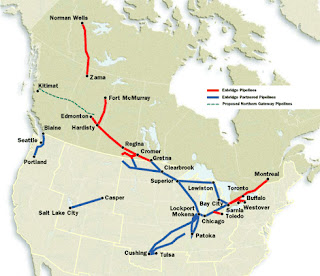 |
| Keystone XL pipe path through Canada and US |
There are some final points about the Enbridge Northern Gateway project. In a recent report Natural Resources Canada itself debates whether the Northern Gateway pipeline is even needed to boost oil exports (c.f.
http://www.pacificwild.org/site/press/1306554738.html), because it turns out that Enbridge has already approved other pipelines, and has an array of other pipelines planned. The Keystone XL pipeline would carry tar sands oil south into the US for export via the Gulf of Mexico. This project has not been approved in the US however, and although still being discussed, President Obama himself has questioned the project, and an April 2, 2011 editorial in the New York Times concluded the project was simply too risky to groundwater aquifers supporting most people living in the central US, and should be denied (New York Times editorial, April 2, 2011:
http://www.pacificwild.org/site/it_will_never_happen_here/1301876176.html ). The growing debate about increasing development of tar sands as an oil source is now underway well beyond British Columbia. The resources of the Gwaii Haanas Marine Reserve on Haida Gwaii Island, and the livelihoods and health of the oceans, fisheries and tourist industry of British Columbia, as well as the culture of the regions’ traditional peoples are at risk from the Enbridge Northern Gateway project. A project Canada and the world really don’t need, which is obvious even to a ten year old.