December 3, 2012
Last week, Mission Blue founder, Dr. Sylvia Earle presented the 2012 Pearl Meister Greengard Prize to Dr. Joan A. Steitz. Dr. Steitz was awarded the prize in honor of her revolutionary discoveries about the biological molecule RNA and the foundation her work has provided for our current understanding of the complex genetics of higher organisms.
At last Thursday’s award presentation, young women in STEM, colleagues, friends, family, and long-time admirers of Dr. Steitz and Earle crowded into an auditorium at The Rockefeller University in New York City. At the event, Dr. Earle spoke about her advocacy efforts on behalf of the world’s ocean before presenting the prize. The true highlight of the evening came as Dr. Steitz accepted the Pearle Meister Greengard Prize from Dr. Earle — the room filled with applause as the two women briefly paused for a photo.
The Pearl Meister Greengard Prize, is awarded annually by The Rockefeller University, and was first established by Dr. Paul Greengard, the University’s Vincent Astor Professor, and his wife, the sculptor Ursula von Rydingsvard. Dr. Greengard donated his monetary share of the 2000 Nobel Prize in Medicine to Rockefeller and, in partnership with generous supporters of the University, created this major international prize. Named in memory of Dr. Greengard’s mother, who died giving birth to him, the Pearl Meister Greengard Prize provides recognition of the accomplishments of women in science.
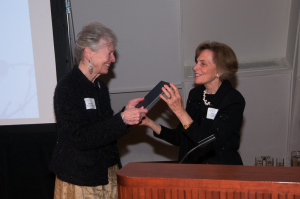
2012 Pearl Meister Greengard Prize Winner Joan Steitz
Joan Steitz is noted for making revolutionary discoveries about the biological molecule RNA. Her work has provided a foundation for our current understanding of the complex genetics of higher organisms, including human beings. In every cell, genes muct be activated — in the parlance of biologists, “expressed” — in order to make the proteins that the cell needs. Through experiments that began with studies of antibodies carried by patients with lupus erythematosus, Dr. Steitz identified small nuclear ribonucleo-proteins (snRNPs) and defined their essential role in a crucial step in gene expression: the processing of messenger RNA.
Research on snRNPs may help to explain why humans, who have only about twice the number of genes as fruit flies, are so much more complex. Dr. Steitz’s influential findings and insights are also being widely applied to investigations of many clinical conditions, including cancer and infectious diseases, as well as autoimmune disorders such as lupus.
Dr. Steitz received a Ph.D. in biochemistry and molecular biology from Harvard University in 1967. Since 1970, she has served on the faculty at Yale University. A member of the National Academy of Sciences, she is a recipient of the Gairdner Foundation International Award, the Albany Medical Center Prize, and the National Medal of Science.
Photos: (c)Scott Rudd